
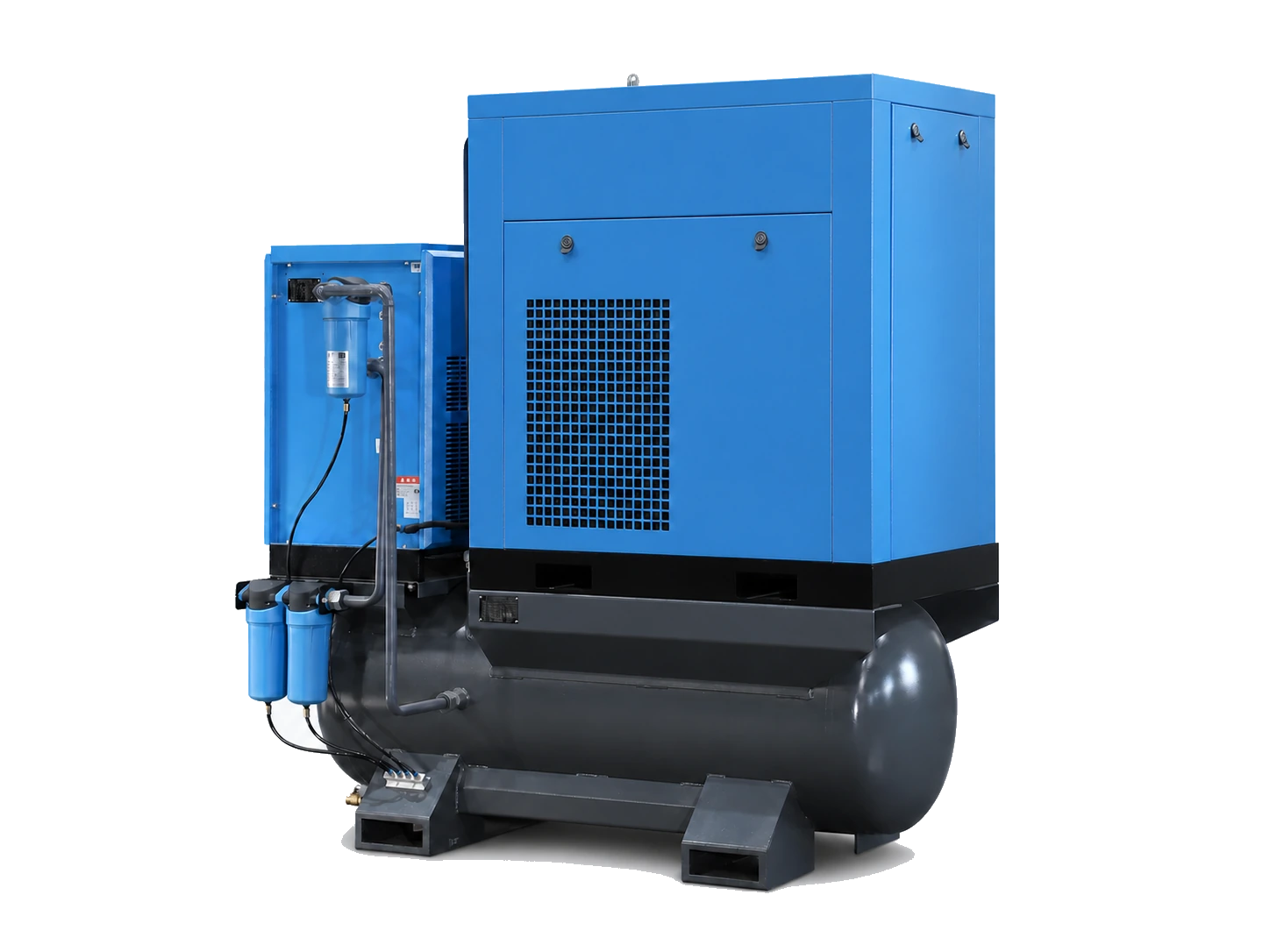
A storage tank helps manage short changes in air demand. Its useful capacity depends on the pressure range available to production and the time allowed for the next refill. Selecting a tank only from the compressor motor rating misses those relationships.
Define the event that storage must cover
Record the extra air demand, its duration and how often it repeats. Separate continuous consumption from brief events such as simultaneous pneumatic movements. Identify the minimum permitted pressure at the affected equipment. Ask whether the problem is a short pressure dip or a sustained shortage: increasing storage volume cannot indefinitely compensate for a compressor that supplies too little air.
Use a flow-deficit estimate carefully
For an initial isothermal estimate, storage volume equals event time multiplied by the difference between demand and available supply, multiplied by absolute atmospheric pressure, then divided by the permitted pressure decrease. Flow values must share the same uncompressed-air reference basis and time units. This simplified estimate does not replace assessment of temperature effects, controls, pipe restrictions or pressure-vessel requirements.
Work through an illustrative event
Assume a demand of 5 m³/min, available supply of 3 m³/min and a 10-second event. At an assumed absolute atmospheric pressure of 1 bar and an allowed pressure decrease of 1 bar, the estimate is (10/60) × (5 − 3) × 1/1 = 0.333 m³, or approximately 333 litres. These invented inputs explain the method; they are not a tank recommendation for a particular factory.
Check refill time and repeated peaks
After the event, there must be enough spare supply and time to refill the tank. Otherwise the next event begins with less stored air. Ask the supplier to show both pressure decay and recovery across a representative production cycle. Check the compressor control response as well: useful storage and the way compressors load, unload or change speed should be evaluated together.
Review location relative to treatment
Storage upstream and downstream of a dryer serves different purposes. A sudden flow from upstream storage can exceed downstream treatment capacity, while appropriately designed dry-air storage can support a short event after treatment. Include the actual flow path, pressure losses and drain arrangement in the review. There is no single best location that can be selected without considering the rest of the system.
Put the operating limits in the handover
Confirm the approved pressure rating, protection devices, inspection obligations, condensate handling and access requirements with the responsible supplier and local competent personnel. Record the allowed operating pressure range and the event used for acceptance. Check pressure at the tank and at the critical machine. Keep that record for future production changes rather than treating the installed tank size as a permanent design rule.