
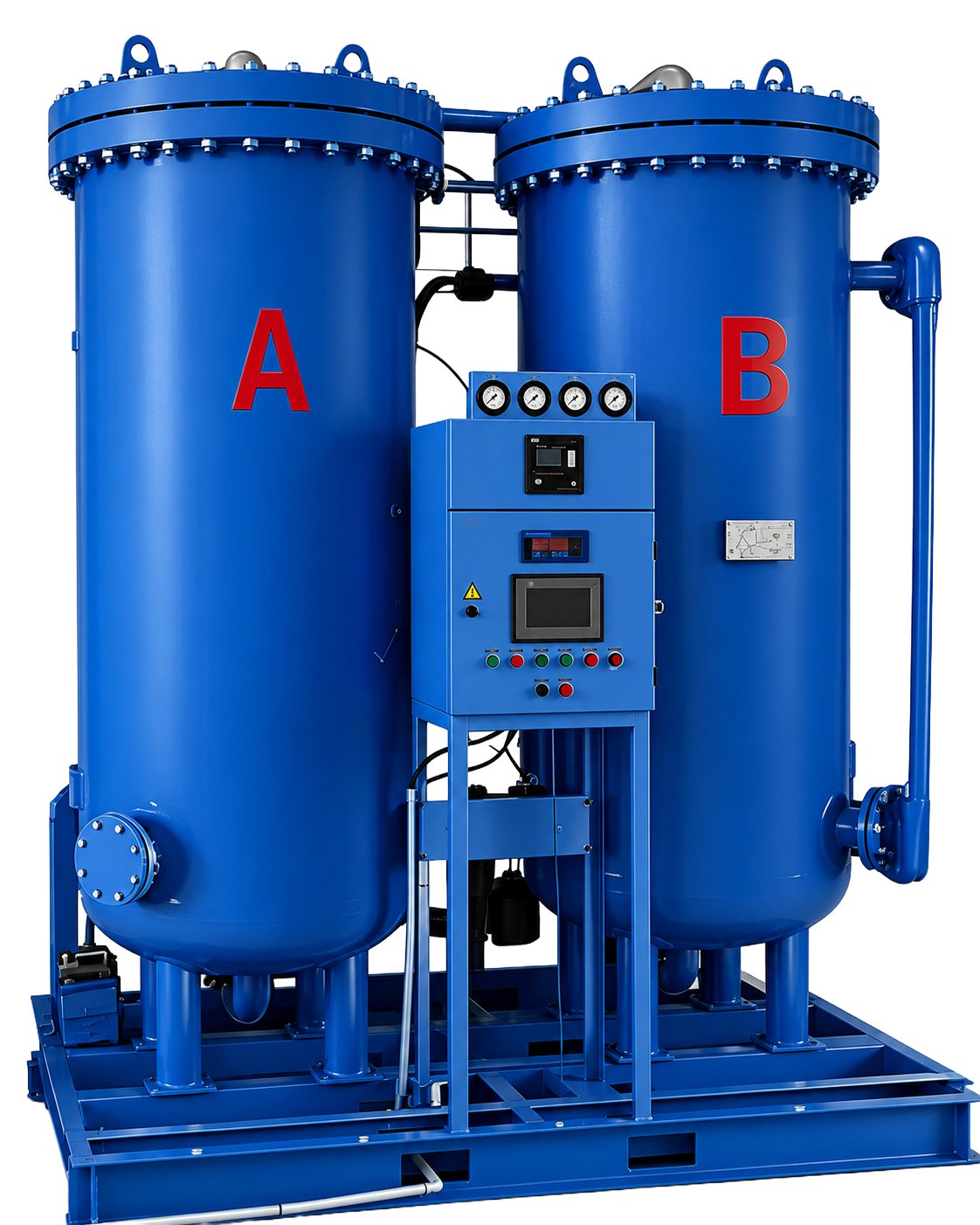
A nitrogen generator must be selected for the required gas quality and delivery pattern together. A high purity figure is not a complete capacity specification. Start at the consuming process, then work upstream through gas storage, generation and compressed-air treatment.
Define nitrogen at the process connection
Record required nitrogen flow, minimum pressure, acceptable impurity limits and the reference conditions used for the flow figure. Ask the process owner to confirm how purity is expressed and measured. Include steady consumption, short peaks and future equipment separately. Normal-volume gas flow and actual pipe-volume flow must not be added without a consistent reference basis.
Understand the PSA operating cycle
Pressure swing adsorption uses an adsorbent to separate components of compressed air, with alternating production and regeneration stages. Product flow and feed-air demand depend on the design, purity target and operating conditions. Ask for the performance corresponding to the actual specification. Do not assume that the highest purity and largest flow printed in a brochure can be obtained simultaneously.
Specify the feed air as a separate requirement
Obtain the generator manufacturer’s limits for inlet pressure, temperature, moisture, particles and oil. Confirm how the compressor, dryer and filters will maintain those conditions across the operating schedule. Include regeneration and other auxiliary consumption where applicable. Existing compressor spare capacity should be demonstrated at the relevant pressure and load, not inferred from motor power or an unused connection.
Review storage and peak delivery
Show the supplier the duration and frequency of demand peaks, together with the minimum pressure at the process. Ask how air storage and nitrogen storage are arranged and how the system recovers between events. A large gas tank does not remove a sustained generation shortfall. For critical production, discuss the required backup or supply continuity arrangement without assuming that one configuration suits every site.
Agree on quality monitoring and abnormal operation
Identify the gas measurement point, instrument range and calibration arrangements. Ask what happens during startup or when gas is outside the agreed quality limits. Review exhaust, ventilation and oxygen-displacement risks with the equipment supplier and site safety personnel. The installation and operating instructions should define the response; a purity display alone is not a complete operating procedure.
Compare quotations on a common boundary
Request nitrogen output at the specified purity and pressure, required feed-air flow and quality, electrical demand, maintenance items, installation scope and acceptance conditions. Include treatment and storage rather than comparing generator cabinets alone. Record the commissioning test and agreed production cycle. This creates a clear basis for evaluating a proposal and for investigating performance changes after the process expands.